The hud2007–hud2025 data frames hold HUD’s
annual Point-in-Time (PIT) estimate of the total (“Overall Homeless”)
population for each Continuum of Care (CoC). The
coc2007–coc2025 objects hold the matching CoC
boundaries as sf polygons.
National overview
National totals over the full series:
years <- 2007:2025
totals <- sapply(years, function(y) sum(get(paste0("hud", y))$count))
plot(years, totals / 1e6, type = "b", pch = 19,
     xlab = "Year", ylab = "Total PIT homeless (millions)",
     main = "U.S. Point-in-Time homeless counts, 2007-2025")
The 2021 dip reflects HUD’s pandemic waiver of the unsheltered count for many CoCs, not a real decline.
Sheltered, unsheltered and total, with ARIMA reconstruction of 2021
pit_us splits the national total into sheltered and
unsheltered counts. The 2021 unsheltered count collapsed because of the
waiver; the sheltered count held up. We treat 2021 as missing and
reconstruct it for each series with an ARIMA model (Kalman smoothing via
imputeTS::na_kalman), shown as hollow points.
library(ggplot2)
series <- c("total", "sheltered", "unsheltered")
yr <- pit_us$year
# ARIMA-impute the 2021 value of one series (2021 set to NA)
arima_2021 <- function(v) {
  x <- v; x[yr == 2021] <- NA
  as.numeric(imputeTS::na_kalman(ts(x, start = min(yr)), model = "auto.arima"))[yr == 2021]
}
obs <- do.call(rbind, lapply(series, function(s)
  data.frame(year = yr, series = s, value = pit_us[[s]])))
imp <- data.frame(year = 2021, series = series,
                  value = vapply(series, function(s) arima_2021(pit_us[[s]]), numeric(1)))

ggplot(obs, aes(year, value, color = series)) +
  geom_line() + geom_point(size = 1.3) +
  geom_point(data = imp, shape = 21, fill = "white", size = 3.2, stroke = 1.1) +
  scale_y_continuous(labels = scales::comma) +
  labs(title = "U.S. PIT homeless by shelter status, 2007-2025",
       subtitle = "Hollow points: ARIMA reconstruction of the waiver-affected 2021 count",
       y = NULL, x = NULL, color = NULL) +
  theme_minimal()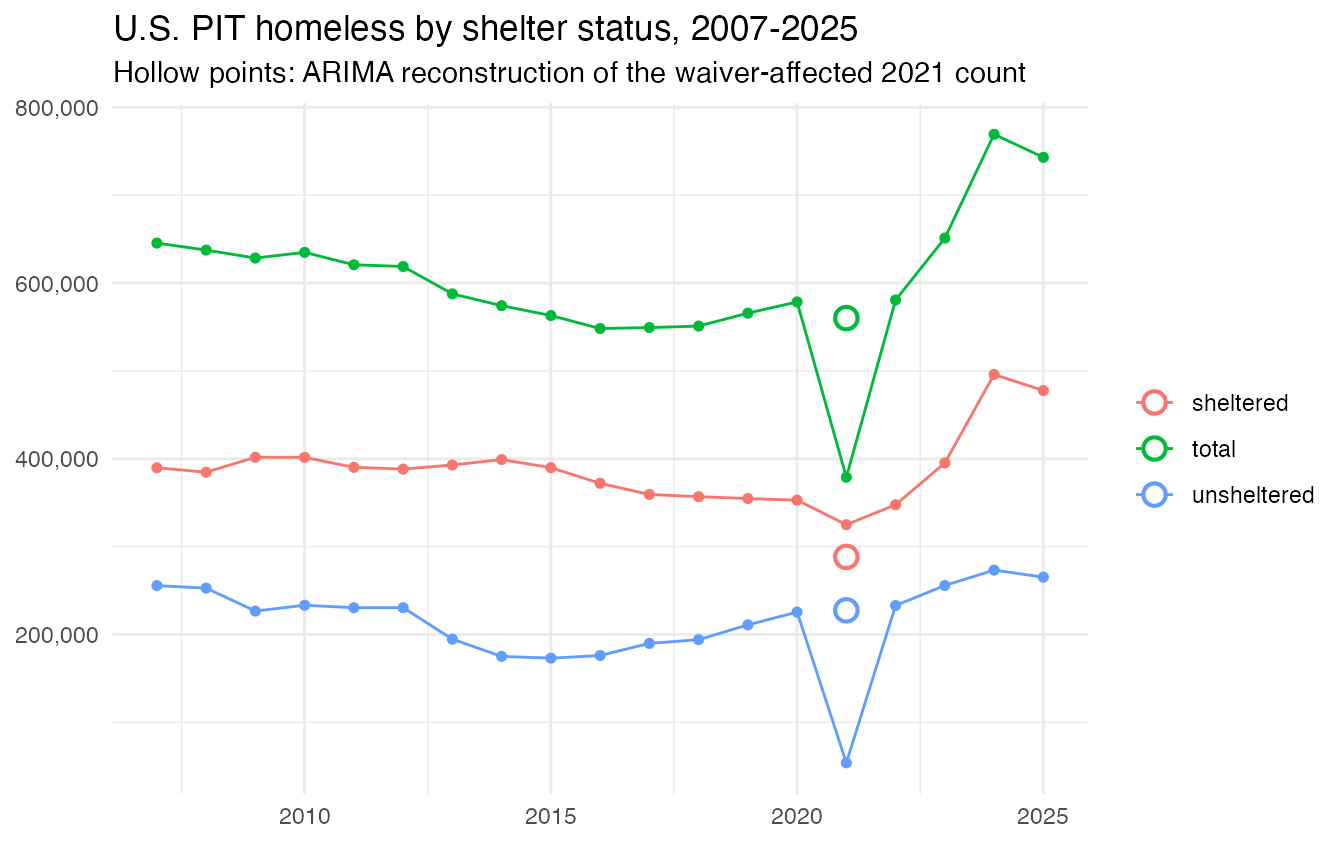
data.frame(series, observed_2021 = sapply(series, function(s) pit_us[[s]][yr == 2021]),
           arima_2021 = round(imp$value))
#>                  series observed_2021 arima_2021
#> total             total        380630     561084
#> sheltered     sheltered        326126     289456
#> unsheltered unsheltered         54504     228220
A national map of 2024, CoCs shaded by PIT count. Alaska and Hawaii
are repositioned with tigris::shift_geometry() for a
compact lower-48 layout:
library(sf); library(ggplot2); library(tigris)
#> Linking to GEOS 3.14.1, GDAL 3.12.3, PROJ 9.8.0; sf_use_s2() is TRUE
#> To enable caching of data, set `options(tigris_use_cache = TRUE)`
#> in your R script or .Rprofile.
# drop the far Pacific/Caribbean territories (shift_geometry only repositions
# AK/HI/PR) so the map stays centered on the lower 48 + insets
conus <- function(x) x[!x$ST %in% c("AS", "GU", "MP", "VI"), ]
m24 <- conus(merge(coc2024, hud2024, by.x = "COCNUM", by.y = "coc_num"))
m24s <- shift_geometry(m24)
ggplot(m24s) +
  geom_sf(aes(fill = count), color = NA) +
  scale_fill_viridis_c(trans = "log10", name = "PIT\nhomeless",
                       labels = scales::comma) +
  labs(title = "Point-in-Time homeless by CoC, 2024") +
  theme_void()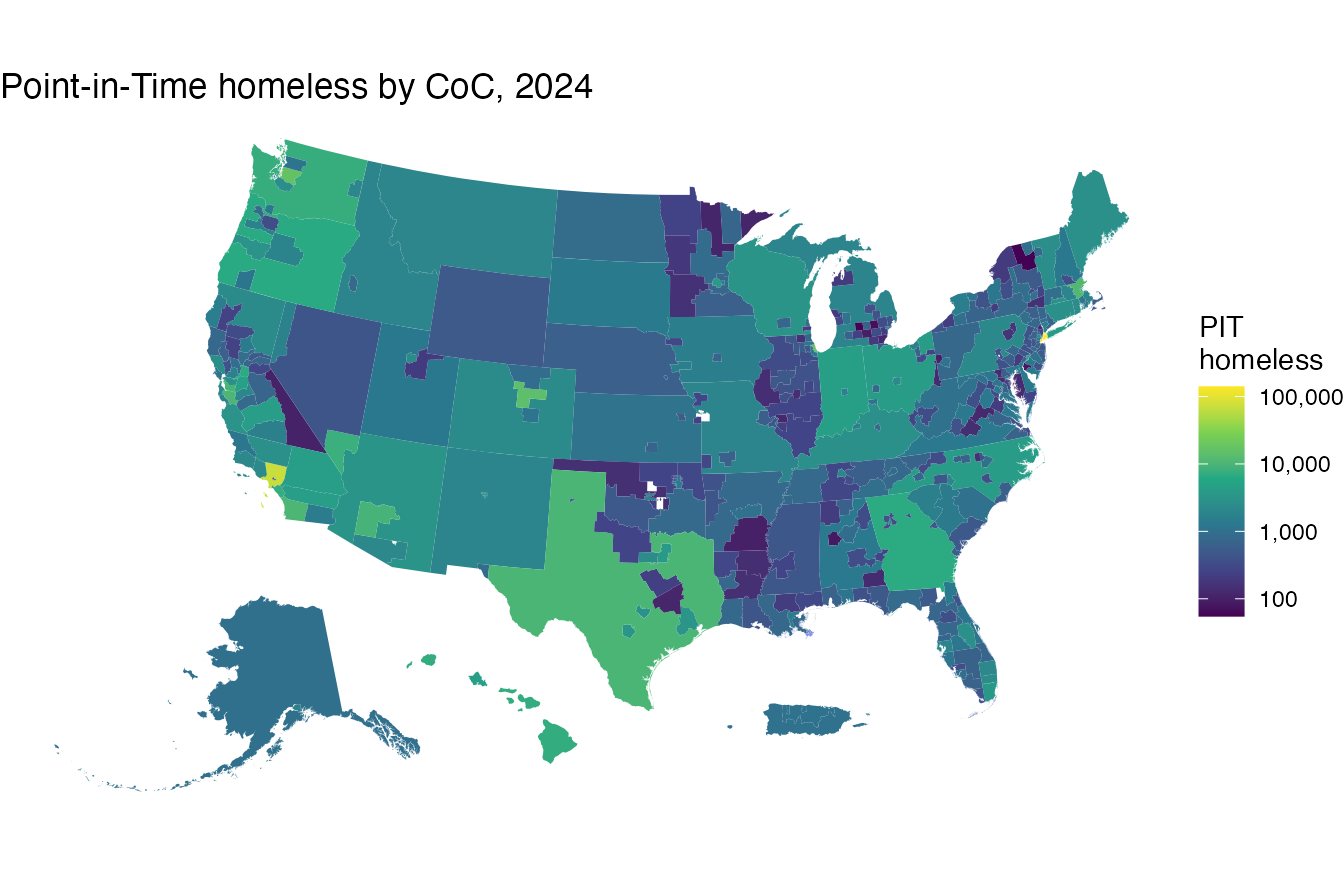
Homeless by gender over time (CoC level)
pit_coc_detail carries HUD’s gender breakdown, available
2014–2024 (dropped from the 2025 release). National totals by gender,
summing across CoCs:
gen_levels <- c("Woman", "Man", "Transgender", "Non Binary",
                "More Than One Gender", "Gender Questioning")
g <- subset(pit_coc_detail, shelter == "Overall" &
            as.character(subpopulation) %in% gen_levels & !is.na(count))
agg <- aggregate(count ~ year + subpopulation, g, sum)
agg$subpopulation <- factor(as.character(agg$subpopulation), levels = gen_levels)
ggplot(agg, aes(year, count, color = subpopulation)) +
  geom_line(linewidth = 0.8) + geom_point(size = 1) +
  scale_y_continuous(labels = scales::comma) +
  labs(title = "U.S. homeless by gender (CoC level), 2014-2024",
       y = NULL, x = NULL, color = NULL) + theme_minimal()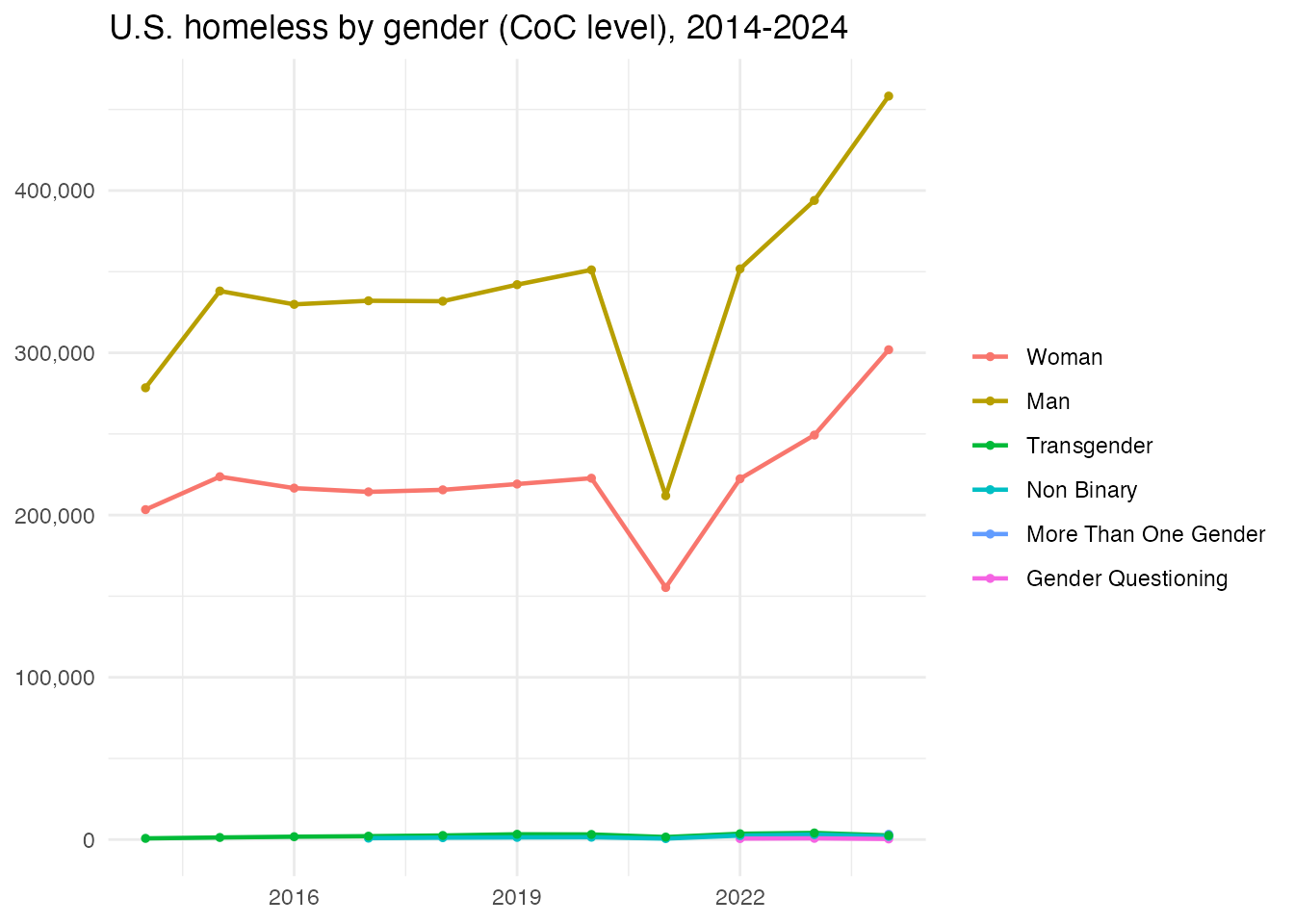
A helper for the two state examples
# the 3 largest CoCs in a state in 2024, and a short label for the map
top_cocs <- function(st, n = 3) {
  s <- m24[m24$ST == st, ]
  s <- s[order(-s$count), ][seq_len(n), ]
  s$label <- paste0(s$COCNUM, "\n", substr(s$COCNAME, 1, 22))
  s
}
# state map: all CoCs shaded by count, top 3 labeled by name
state_map <- function(st, title) {
  s <- m24[m24$ST == st, ]
  tp <- top_cocs(st)
  ggplot(s) +
    geom_sf(aes(fill = count), color = "grey70") +
    geom_sf_text(data = tp, aes(label = label), size = 2.6, fontface = "bold") +
    scale_fill_viridis_c(trans = "log10", name = "PIT", labels = scales::comma) +
    labs(title = title) + theme_void()
}
# per-CoC time series 2007-2025 for a set of CoC numbers
coc_series <- function(coc_nums) {
  do.call(rbind, lapply(coc_nums, function(cc) data.frame(
    year = years, COCNUM = cc,
    count = sapply(years, function(y) {
      d <- get(paste0("hud", y)); v <- d$count[d$coc_num == cc]
      if (length(v)) v else NA_real_ }))))
}
California
state_map("CA", "California: PIT homeless by CoC, 2024 (top 3 labeled)")
#> Warning in st_point_on_surface.sfc(sf::st_zm(x)): st_point_on_surface may not
#> give correct results for longitude/latitude data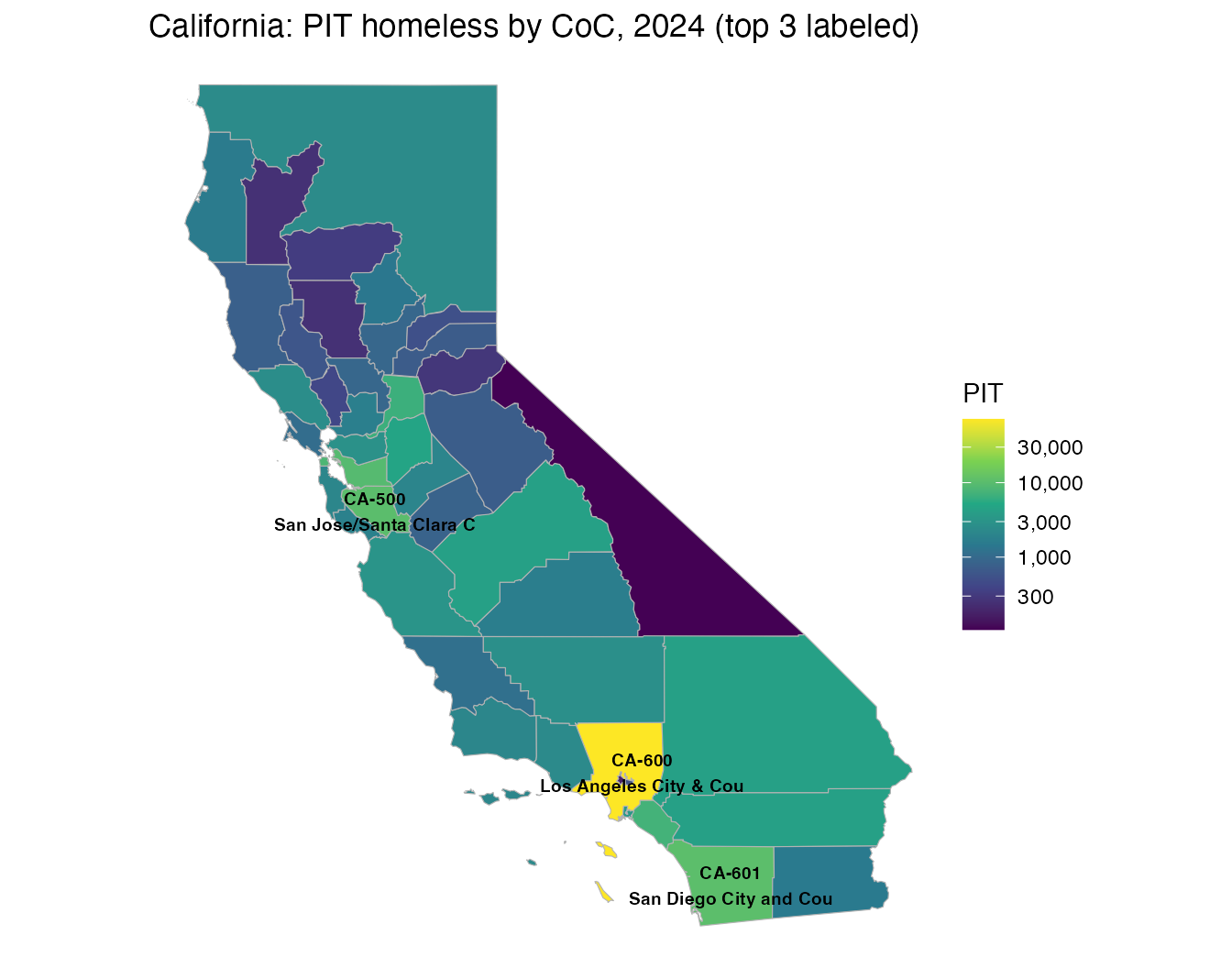
Year-by-year trend for California’s three largest CoCs:
ca_top <- top_cocs("CA")
ggplot(coc_series(ca_top$COCNUM), aes(year, count, color = COCNUM)) +
  geom_line(linewidth = 0.9) + geom_point(size = 1.3) +
  scale_color_discrete(labels = setNames(substr(ca_top$COCNAME, 1, 28), ca_top$COCNUM)) +
  labs(title = "California: largest CoCs, 2007-2025", y = "PIT homeless",
       color = NULL) + theme_minimal()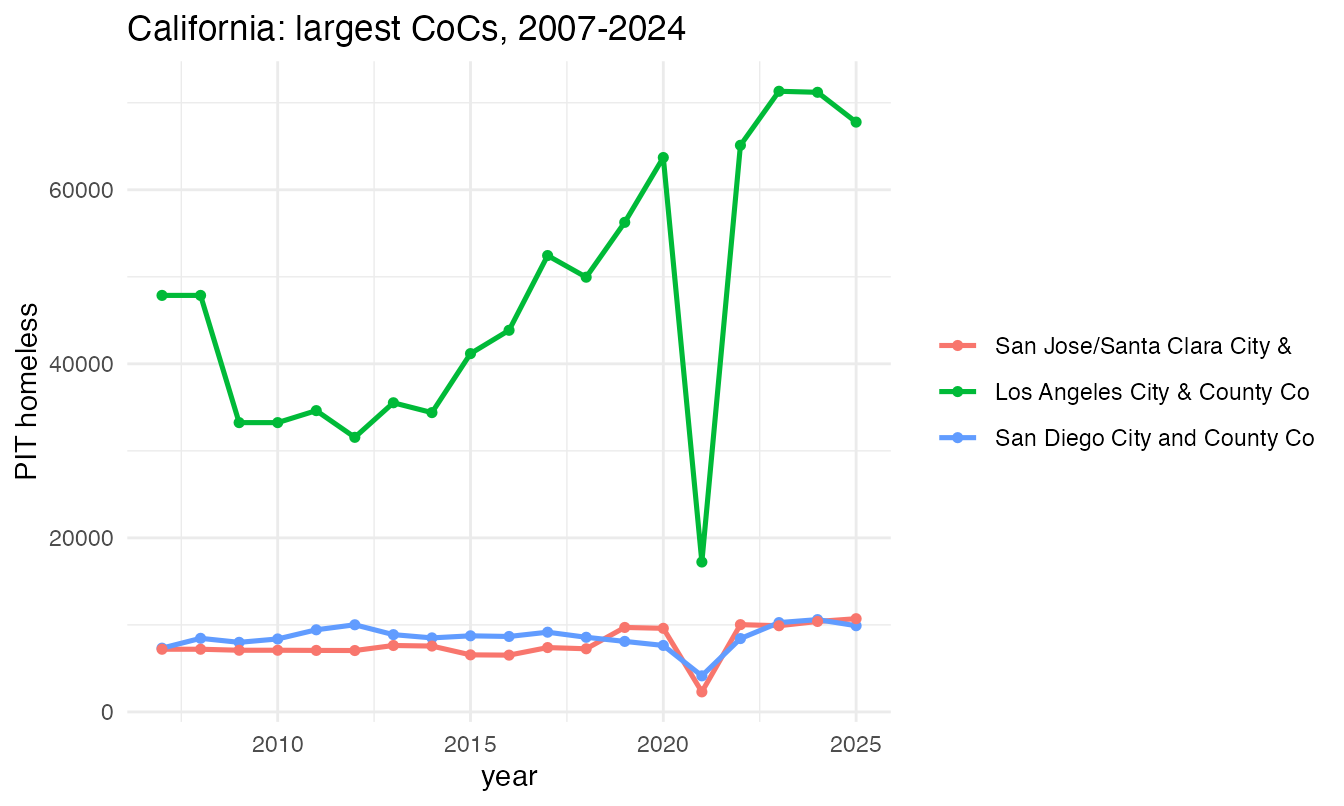
Washington
state_map("WA", "Washington: PIT homeless by CoC, 2024 (top 3 labeled)")
#> Warning in st_point_on_surface.sfc(sf::st_zm(x)): st_point_on_surface may not
#> give correct results for longitude/latitude data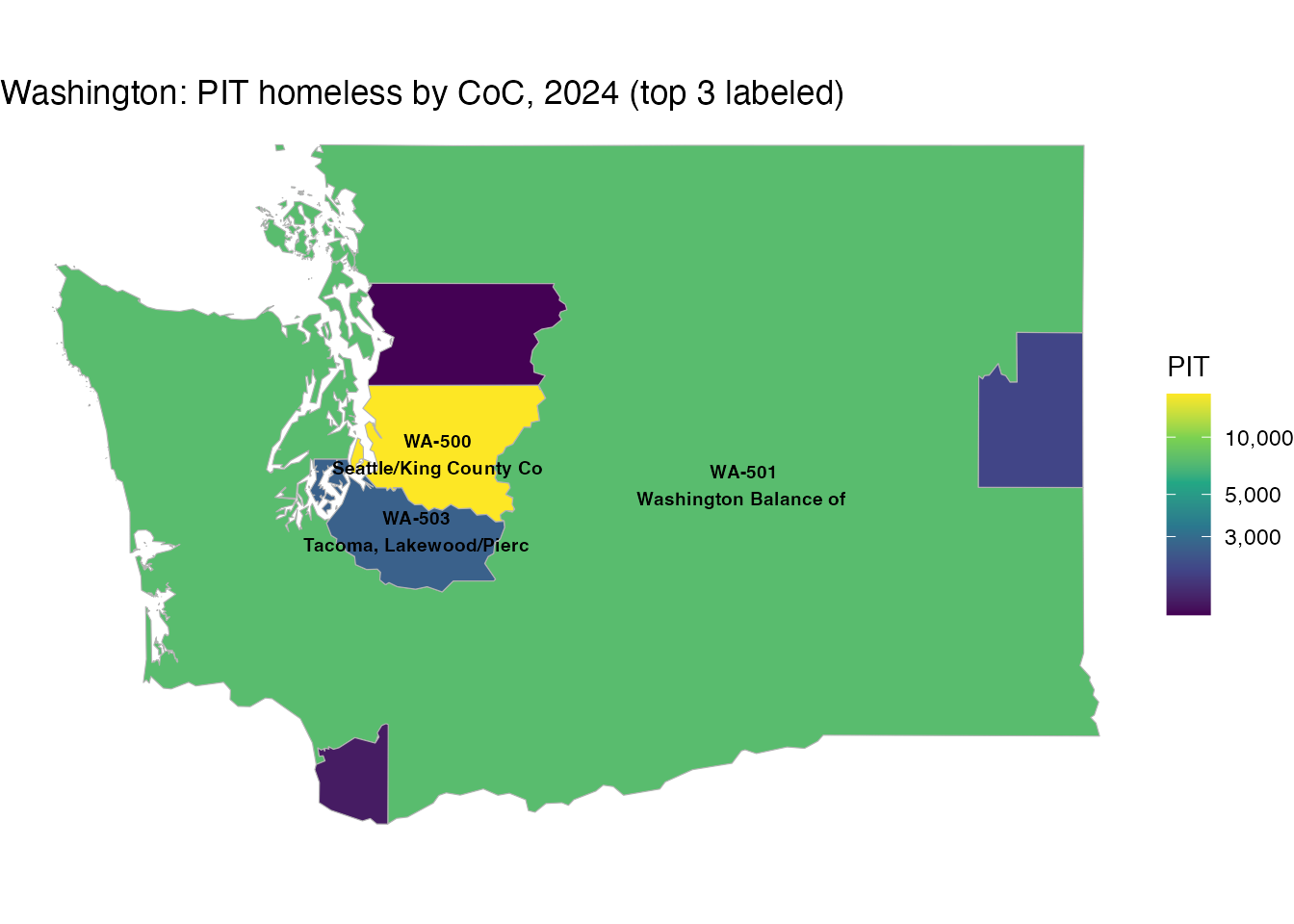
Year-by-year trend for Washington’s three largest CoCs:
wa_top <- top_cocs("WA")
ggplot(coc_series(wa_top$COCNUM), aes(year, count, color = COCNUM)) +
  geom_line(linewidth = 0.9) + geom_point(size = 1.3) +
  scale_color_discrete(labels = setNames(substr(wa_top$COCNAME, 1, 28), wa_top$COCNUM)) +
  labs(title = "Washington: largest CoCs, 2007-2025", y = "PIT homeless",
       color = NULL) + theme_minimal()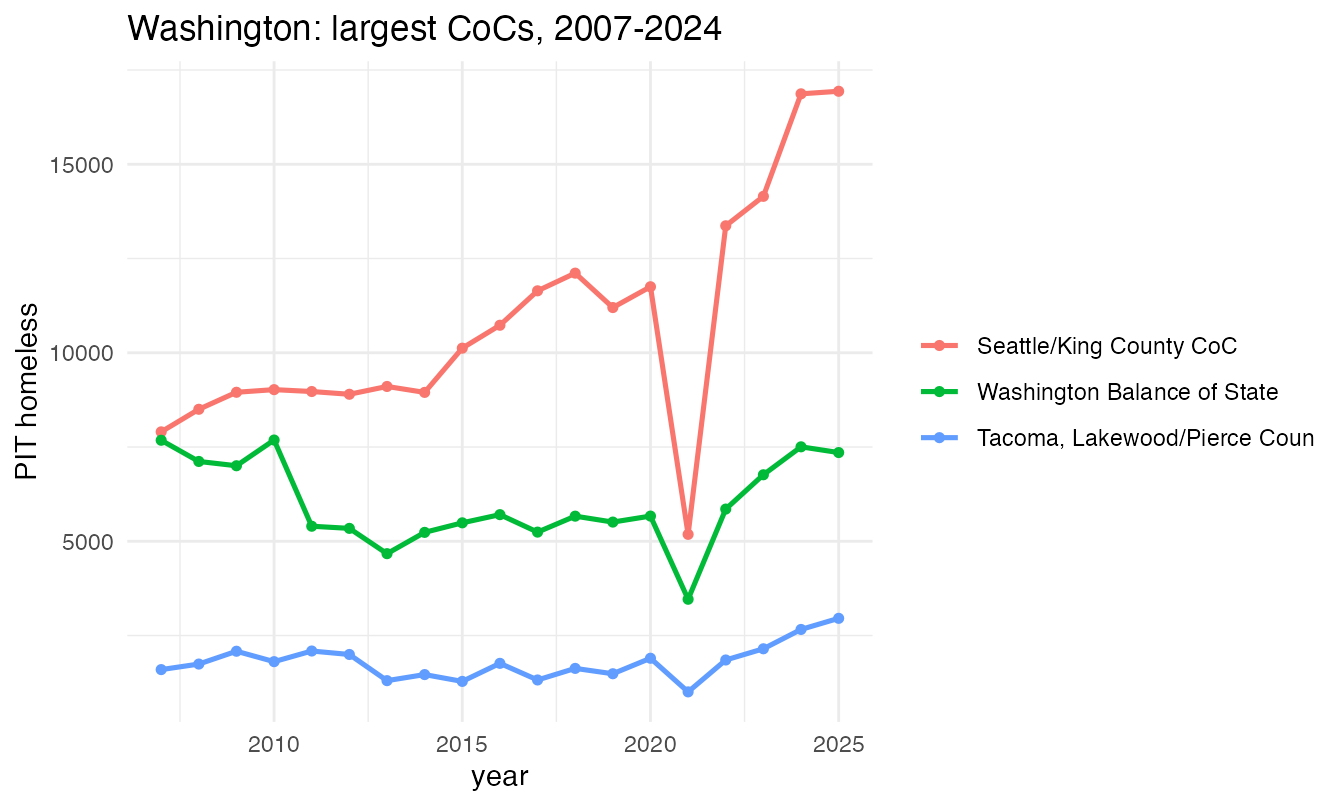
CoCs merge and are renumbered over time; use coc_mergers
to follow a CoC through a merger (see ?coc_mergers).